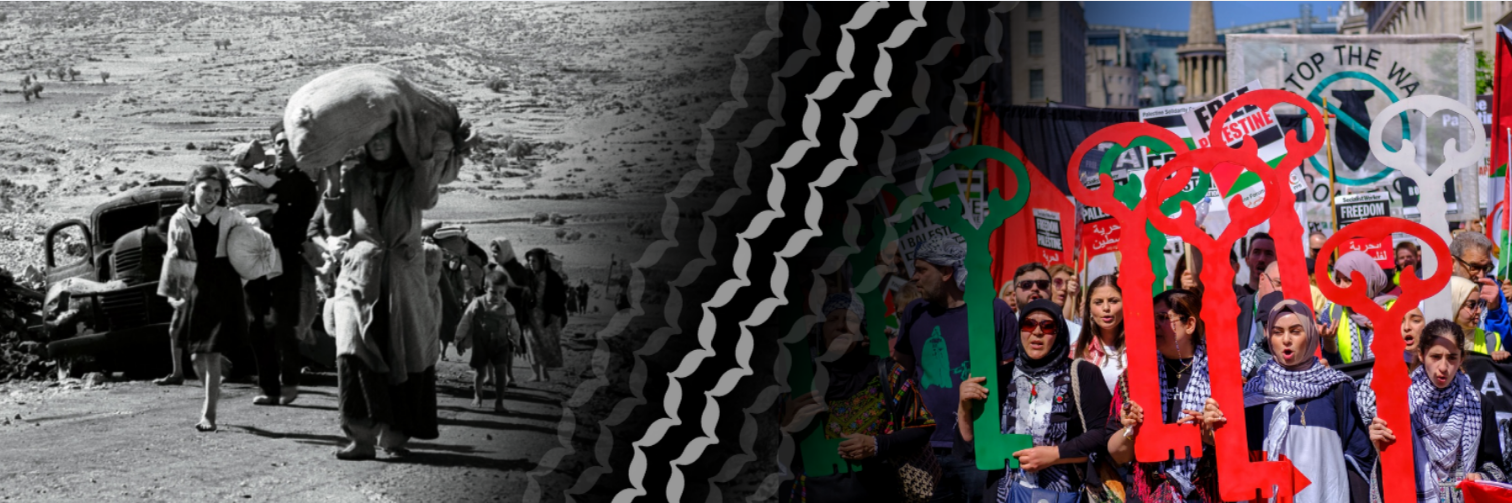
THE NAKBA: 1947–1949
Between 1947-1949, Zionist militias instigated a campaign of ethnic cleansing across historic Palestine, destroying over 500 villages and towns and driving over 750,000 Palestinians from their homes, the vast majority of the Palestinian people. Tens of thousands of Palestinians were killed, and the newly formed State of Israel forcibly seized 78% of historic Palestine. Later, the militias responsible for these crimes would be merged to form the Israeli military.
The aim of this ethnic cleansing campaign was to permanently alter the demographics of this new state, to ensure a Jewish majority on the land, with a minimum number of native Palestinians remaining as second-class citizens.
Palestinians later gave these events the name ‘Nakba’, the Arabic word for catastrophe.
THE NAKBA IS ONGOING
The Nakba did not end in 1948.
Israel continues to expel and dispossess Palestinians from their homes, and millions of Nakba refugees and their descendants continue to live in refugee camps today either in Palestine, or across the Arab world. The vast majority of Palestinians now live outside their homeland, but they have not given up their insistence on returning home.
Under international law, Palestinian refugees and their descendants have the right to return to their land. The Right of Return is one of the inalienable rights of the Palestinian people, a right that cannot be taken or traded away.
Since 1948, the State of Israel, through a body of racist laws, has systematically denied Palestinians their right to return to their own homeland in order to preserve Israel’s character as a ‘Jewish state’. By contrast, Jewish people from across the world are able to obtain automatic citizenship on that same land as a legal right – no matter where they were born. This forms a part of Israel’s system of apartheid.
THE KEY: A SYMBOL OF RETURN
Palestinians continue to resist this racist system – Nakba refugees fled holding the keys to their homes, passing them down through the generations. The key has become a Palestinian national symbol of resistance, evoking both the hope and the promise that the Palestinian people will return to Palestine.

Actions and Resources
Check out our Nakba Stories series
Hear about real experiences, recounting the 1948 Nakba in Palestine.
Are you a PSC Branch Officer?
Check out our new Nakba leaflets, here.
