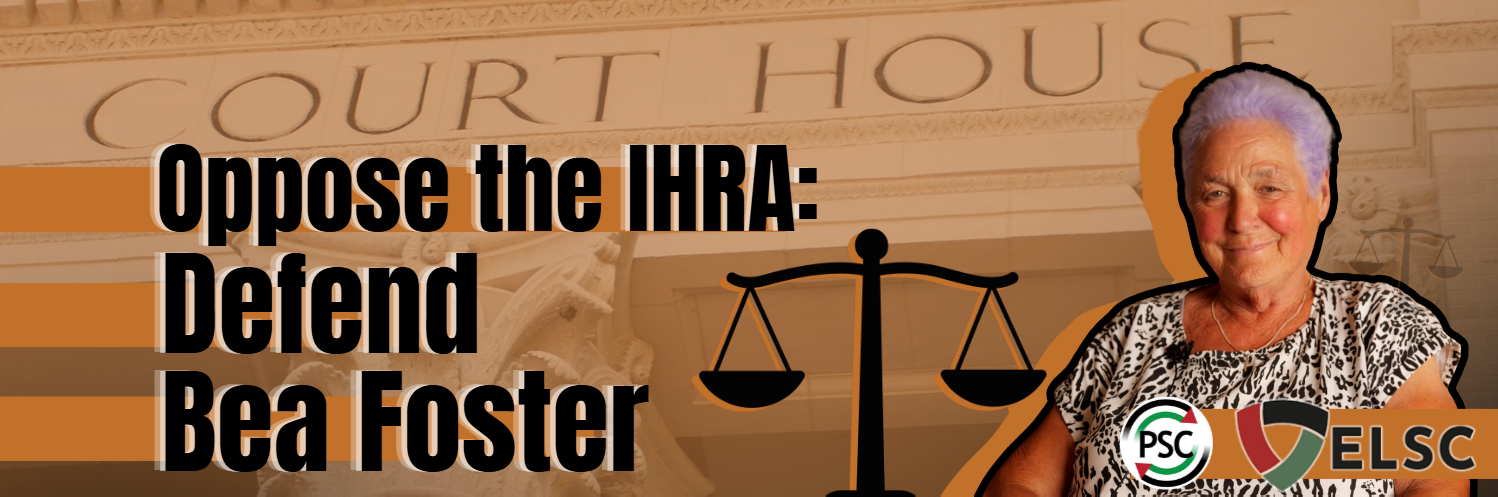
The International Holocaust Remembrance Alliance (IHRA) definition of antisemitism is not really an anti-racist tool as presented. Instead, it is a tool used to suppress campaigning for Palestinian rights.
The British government recently used the IHRA in a discriminatory way against Bea Foster – a 76-year-old interfaith peace activist – over social media posts where she demanded an end to Israel’s genocide and apartheid against the Palestinian people.
We are supporting the European Legal Support Centre (ELSC) in launching a landmark human rights case against the British government to challenge this and to defend all of our rights to campaign for Palestine.
This case is not just about Bea, it is crucial to challenging the IHRA overall.
Support the case today to demand Bea Foster is reinstated, to oppose the IHRA, and to send a clear message to the government that we will never be silenced in our support for Palestine.
Donate today: oppose the IHRA
Fund the legal case today

Watch Bea’s story below:
Bea Foster's Case
For more than two decades, Bea Foster has dedicated her life to fighting racism, building community cohesion, and standing in solidarity with the Palestinian people.
She helped create Building Bridges Burnley, an interfaith charity committed to dialogue, inclusion and social justice. In 2023, the Department for Culture, Media and Sport (DCMS) gave the charity the King’s Award for Voluntary Service, one of the highest awards for voluntary organisations.
In 2025, the charity came under scrutiny after media allegations of antisemitism were made in relation to the social media posts shared by Bea in which she condemned Israel’s crimes.
The government then intervened and threatened to withdraw the prestigious DCMS award unless Bea resigned as a trustee and took a 3-year ban from any involvement with the charity. The government relied on the IHRA to justify its position, citing her posts as evidence.
Bea felt she had no option but to step down to avoid any repercussions for the charity.
Now Bea is fighting back, and so are we.
Donate to support the ELSC’s legal proceedings against the British government to challenge its decision and defend Bea’s – and all of our – rights.
Donate today: oppose the IHRA
Fund the legal case today
What is the IHRA definition of antisemitism?
The controversial IHRA is a 39-word definition that describes antisemitism as a “certain perception of Jews.”
It is accompanied by illustrative examples which rely on the dangerous conflation of Judaism and Jewish people with the state of Israel.
The IHRA has therefore been used to extend the concept of antisemitism beyond racism against Jewish people to include criticism of Israel as a political entity.
This makes it bad for the crucial fight against antisemitism and bad for our ability to stand up for Palestinian rights.
Why oppose the IHRA definition of antisemitism?
The IHRA definition of antisemitism is too vague and poorly worded to effectively dismantle antisemitism. It is not for fit for purpose.
It serves to delegitimise points of view critical of Israel, and those in support of Palestinian rights, as antisemitic.
It is used to undermine our ability to hold Israel accountable for its oppression of the Palestinian people.
The IHRA definition has received widespread critique and has been rejected by a range of legal experts, academics, and civil society groups for these reasons.
Why is Bea Foster’s case so important?
The government’s discriminatory action against Bea Foster is a clear example how of the IHRA is used to try to silence or punish people who stand up for Palestinian rights.
ELSC’s legal case on behalf of Bea will challenge the IHRA’s compatibility with the right to freedom of expression and association as guaranteed in the Human Rights Act.
Opposing the use of the IHRA definition is therefore essential to protecting our fundamental human rights, and to ensuring that solidarity with the Palestinian people cannot be silenced.
If Bea wins her case, it could set a positive precedent to show that the IHRA in and of itself is not fit for purpose and should not be used again.
Donate today: oppose the IHRA
Fund the legal case today